
Alphabet’s $2 Trillion Gain Turns AI Market Favorite Into a Question Mark
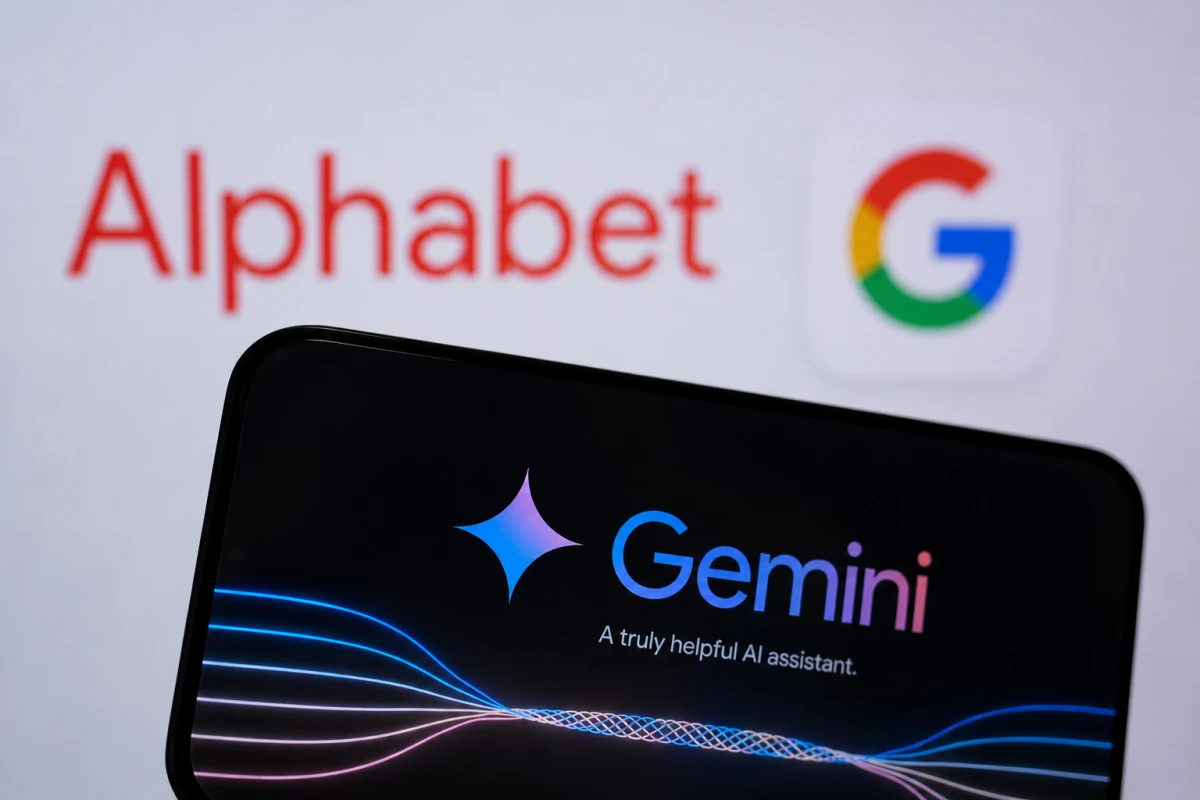
Alphabet’s $2 trillion market value gain has made Google’s parent company one of the biggest winners of the artificial intelligence boom, but recent weakness in Alphabet stock is raising new questions about AI spending, cash flow, valuation and whether investors still see the company as a clear long-term winner.

What Happened
Alphabet Inc. has delivered one of the most remarkable market runs in global technology, adding more than $2 trillion in value over the past 12 months as investors embraced its artificial intelligence strategy, cloud growth, advertising strength and semiconductor ambitions.
The company, best known as the parent of Google, now carries a market capitalization of roughly $4.3 trillion, making it the second-most valuable company in the world. That rise marks a dramatic shift from a year ago, when investors were still debating whether AI chatbots and generative search tools could threaten Google’s core search business.
Alphabet’s gains have been driven by renewed confidence in Gemini, its artificial intelligence model family, as well as growing interest in its custom chips, cloud platform and digital advertising machine. The company’s addition to the Dow Jones Industrial Average this week further highlighted its importance to the broader U.S. economy and stock market.
Yet the celebration has recently become more complicated. Alphabet shares fell 6% in June and have declined in four of the past five months. The stock remains higher for the year, helped by a strong April rebound, but its 2026 performance has lagged the Nasdaq 100 Index after a much stronger rally in 2025.
Key Details
Alphabet is still viewed as one of the most important companies in artificial intelligence. Its Gemini models have gained traction among users and developers, while Google Cloud continues to benefit from enterprise demand for AI tools and infrastructure. The company also has a powerful position in digital advertising, where search, YouTube and related ad products continue generating significant profit.
However, the market’s attitude toward AI has shifted. Earlier in the AI rally, investors rewarded companies making aggressive artificial intelligence investments. More recently, attention has moved toward the suppliers of AI infrastructure, especially chipmakers and hardware companies that are seeing direct demand from the data center buildout.
That shift has left companies with enormous AI spending plans under greater scrutiny. Alphabet has said it plans to spend as much as $190 billion on capital expenditures this year, largely to support data centers, chips and other infrastructure required for artificial intelligence workloads.
The company also announced plans in June to raise about $85 billion through equity sales to help fund those expenditures. That move weighed on investor sentiment because new equity issuance can dilute existing shareholders, especially if the market is unsure how quickly the spending will generate returns.
Analysts are also watching Alphabet’s free cash flow. After producing more than $73 billion in free cash flow in 2025, expectations point to a sharp decline in 2026 and 2027 as capital spending rises. That decline does not mean Alphabet is financially weak, but it does create uncertainty around how much cash the company can return to shareholders while funding its AI ambitions.
Why It Matters
Alphabet’s stock matters because it sits at the center of several major market themes: artificial intelligence, digital advertising, cloud computing, consumer technology and mega-cap equity leadership. When a company of this size struggles, it can influence investor sentiment across the entire technology sector.
The recent weakness also shows how quickly the AI trade can change. A company can move from being seen as an AI winner to facing questions about spending discipline, talent retention and competitive positioning. In Alphabet’s case, investors are balancing its long-term strengths against short-term concerns about capital intensity.
Competition remains another key issue. Alphabet is racing against other AI leaders, including major cloud providers, model developers and AI coding companies. Reports of high-profile AI researchers leaving for competitors have added to concerns that Alphabet must keep investing aggressively to protect its leadership position.
At the same time, Alphabet still has advantages that few rivals can match. It owns one of the world’s most profitable advertising businesses, operates a major cloud platform, develops advanced AI models, builds custom chips and has deep technical infrastructure. It also has exposure to other leading AI companies through investments and partnerships.
For long-term investors, the debate is not simply whether Alphabet can afford its AI spending. The larger question is whether that spending will produce enough future revenue, profit and strategic control to justify the near-term hit to free cash flow.
What Happens Next
Investors will closely watch Alphabet’s next earnings reports for signs that AI spending is translating into measurable growth. Key areas include Google Cloud revenue, advertising performance, Gemini adoption, AI product monetization and updated capital expenditure guidance.
Any indication that capex could rise further in 2027 may increase pressure on the stock, especially if free cash flow expectations continue to fall. On the other hand, stronger AI revenue, improved margins or evidence of disciplined spending could restore confidence.
Analysts will also monitor Alphabet’s valuation. The stock trades above its 10-year average earnings multiple and at a higher valuation than some other large AI spenders. That premium can be justified if growth accelerates, but it also leaves less room for disappointment.
Another major factor will be investor appetite for mega-cap technology stocks. The broader group of large AI-related companies has struggled this year, while other parts of the market have performed better. If investors return to mega-cap AI platforms, Alphabet could benefit. If the rotation continues toward chipmakers and infrastructure suppliers, the stock may remain under pressure.
Key Facts
- Alphabet’s market value has increased by more than $2 trillion over the past 12 months.
- The company is now valued at about $4.3 trillion, making it the second-most valuable company in the world.
- Alphabet shares fell 6% in June and have declined in four of the past five months.
- The company plans to spend as much as $190 billion on capital expenditures this year.
- Investors are focused on whether Alphabet’s AI spending will generate enough long-term cash flow and earnings growth.
Conclusion
Alphabet’s $2 trillion gain has confirmed its place as one of the defining companies of the artificial intelligence era, but its recent stock weakness shows that investors are becoming more selective about AI winners. The company still has powerful advantages in search, advertising, cloud computing, AI models and custom chips, yet the market now wants proof that massive AI capital spending will produce durable returns. For Alphabet stock, the next major test will be whether growth, cash flow and AI monetization can support the company’s elevated valuation.
Frequently Asked Questions
What's Your Reaction?
 Like
0
Like
0
 Dislike
0
Dislike
0
 Love
0
Love
0
 Funny
0
Funny
0
 Wow
0
Wow
0
 Sad
0
Sad
0
 Angry
0
Angry
0











Comments (0)